
From Products to Procedures, and Why Korea Became the Global Reference Point
For most American consumers, Korean beauty once meant skincare products.
Sheet masks, glass-skin routines, and viral serums dominated search results and social media feeds.
But in 2026, something has changed.
Search behavior, travel data, export statistics, and medical spending trends all point in the same direction:
global interest has moved beyond Korean products to Korean beauty systems.
Americans are no longer just asking what Koreans use.
They are asking what Koreans actually do for their skin.
The Shift Behind the Search Explosion
Recent global data explains why keywords like:
- “Korean skin clinic”
- “beauty tourism Korea”
- “Korean laser treatment”
- “HIFU Korea”
- “best skin treatment in Seoul”
are climbing rapidly in U.S.-based searches.
In 2025 alone:
- Korea recorded record-high cosmetics exports, with the United States becoming the largest destination, surpassing China.
- Medical tourism spending exceeded USD 1.5 billion, with skin clinics accounting for the majority.
- Monthly medical tourism spending set new records consecutively, driven by repeat dermatological procedures rather than surgery.
- Foreign spending on beauty and wellness products rose over 40% year-over-year.
These are not influencer trends.
They are consumer behavior shifts.
Why Skin Clinics — Not Plastic Surgery — Lead the Boom
When Americans hear “medical tourism,” plastic surgery often comes to mind.
But Korea’s growth tells a different story.
The fastest-growing segment is dermatology-based aesthetic care.
Why?
Because skin treatments are:
- Non-invasive or minimally invasive
- Safe for repeat visits
- Focused on skin quality, aging prevention, and maintenance
- Suitable for both men and women
- Compatible with busy schedules
Procedures like laser toning, RF tightening, and ultrasound lifting do not require weeks of recovery.
Many international visitors schedule them between sightseeing, shopping, and work travel.
Skin care has become maintenance, not transformation.
The Technology Factor Americans Are Paying Attention To
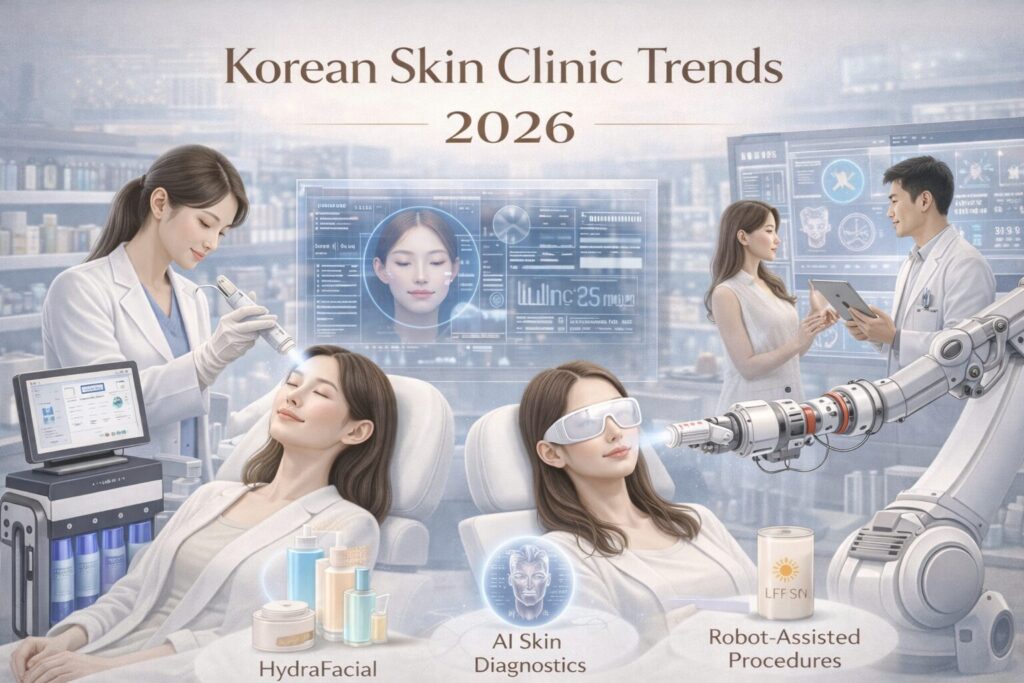
Another reason U.S. interest has intensified is Korea’s dominance in energy-based beauty devices.
Korean companies lead globally in:
- High-Intensity Focused Ultrasound (HIFU)
- Radiofrequency (RF) skin tightening
- Laser-based rejuvenation
- AI-guided skin diagnostics
At CES 2026, Korean beauty-tech companies stood out not for branding, but for results-oriented design.
Key features repeatedly highlighted:
- AI-based skin analysis
- Device + skincare integration
- Data-backed personalization
- Longevity-focused treatment models
For American consumers increasingly skeptical of marketing claims, visible outcomes supported by data matter more than ever.
Why Korea Succeeded Where Others Didn’t
Many countries offer cosmetic procedures.
Few have built a repeatable, scalable beauty ecosystem.
Korea’s advantage comes from integration:
- Clinics that work with device manufacturers
- Skincare designed for pre- and post-procedure care
- Retail channels aligned with clinical routines
- Tourism infrastructure adapted to medical visitors
Instead of selling isolated products, Korea exports processes.
This is why visitors don’t just leave with treatments — they leave with routines, subscriptions, and long-term purchasing habits.
What China’s Reopening Means — and Why It Matters Less to Americans
Recent discussions around China potentially easing restrictions on Korean businesses have made headlines.
But for U.S. consumers and brands, the significance is limited.
During years of geopolitical uncertainty, Korean beauty companies:
- Diversified markets aggressively
- Built strong U.S., Japanese, and European positions
- Reduced reliance on any single country
China now represents optional upside, not core survival.
For Americans, this reinforces confidence:
Korean beauty’s growth is globally anchored, not regionally fragile.
Why the U.S. and Japan Anchor the “Second Wave” of K-Beauty
The current phase of Korean beauty expansion is no longer driven by novelty.
It is stabilized by two markets:
United States
- High acceptance of clinical skincare
- Large and diverse consumer base
- Strong online-to-offline conversion
- Retail presence across Amazon, ULTA, Costco, Walmart, and TikTok Shop
Japan
- Deep skincare culture
- Long-term routine adoption
- High trust in safety and efficacy
- Strong offline retail networks
Together, these markets shape K-Beauty’s second wave — defined by consistency, not virality.
Why This Topic Attracts Massive U.S. Search Volume
This subject intersects multiple high-interest American concerns:
- Aging populations
- Preventive health
- Results-driven skincare
- Experiential travel
- Technology-backed wellness
Korean beauty sits at the center of all five.
That is why search interest continues to rise — not spike and fade.
What Americans Are Really Searching For
The underlying question is no longer:
“What Korean product is trending?”
It has become:
“What actually works — and how do I experience it myself?”
This explains the growth of:
- Beauty-focused travel
- Clinic-centered routines
- Device-assisted home care
- Subscription-based skincare
Beauty is no longer judged at purchase.
It is judged over months, outcomes, and repeat behavior.
Final Takeaway for Global Readers
Korean beauty in 2026 is not about exporting creams or trends.
It is about exporting:
- Systems
- Technology
- Experience
- Trust
That is why Americans are not just buying Korean beauty —
they are traveling, researching, and restructuring their routines around it.
This shift is not temporary.
It is the new baseline.
This article is for informational purposes only and does not constitute medical or professional advice.