
Moving Beyond the 10-Step Myth
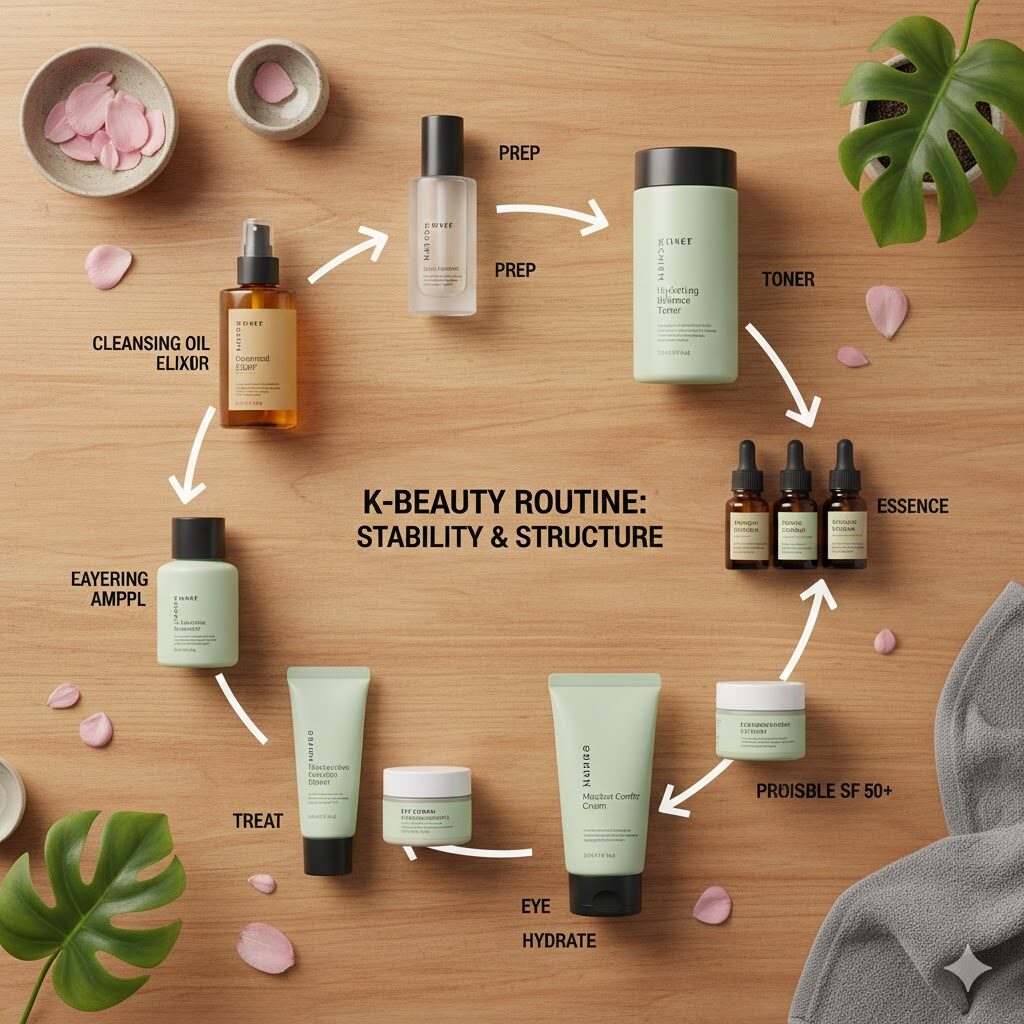
Global interest in K-Beauty often begins with curiosity about the so-called “10-step skincare routine.” While the number itself has become a popular talking point, it oversimplifies what Korean skincare is fundamentally about. K-Beauty is not a rigid formula defined by steps, but a structural approach to skin stabilization.
Unlike many Western skincare philosophies that emphasize rapid transformation through high-strength active ingredients, K-Beauty focuses on creating an environment where the skin can recover, adapt, and maintain balance over time. Layering is not an aesthetic ritual—it is a deliberate strategy designed to support the skin’s natural repair mechanisms.
The Science Behind Incremental Absorption
At the core of K-Beauty lies the principle of incremental stimulation. Human skin is biologically wired to respond cautiously to sudden, intense changes. When exposed to a single high-concentration product, the skin barrier may interpret this as stress, leading to inflammation, redness, or reduced absorption efficiency.
Layering lightweight, water-based formulas before applying richer creams creates a functional gradient. Each layer prepares the skin to receive the next, allowing active ingredients to penetrate without overwhelming the barrier. This approach mirrors how the skin naturally absorbs moisture from its environment—gradually, not abruptly.
From a physiological standpoint, skin repair is not triggered by intensity but by consistency. The barrier strengthens when it receives steady, predictable signals rather than sporadic shocks.
Why Predictability Is Essential for Skin Recovery
One of the most common frustrations among skincare users is the perceived lack of immediate results. However, this impatience often misunderstands how skin recovery works. Before visible improvements can occur, the skin prioritizes stability. If a routine is frequently altered or overly aggressive, the skin redirects its resources toward defense rather than renewal.
K-Beauty routines function as stabilizers. By maintaining a predictable structure through consistent layering, the skin gradually shifts out of survival mode. Over time, this calm state allows hydration levels to normalize, inflammation to subside, and texture to improve naturally.
The widely admired “glass skin” effect is not the result of a single miracle product. It is the visible outcome of a barrier that is deeply hydrated, evenly supported, and free from chronic irritation.
Strategic Consistency Versus Short-Term Intensity
In skincare, effectiveness is not measured by strength alone but by appropriateness and duration. High-intensity treatments such as exfoliating acids or retinoids can be beneficial when used strategically. However, without a stable foundation, these treatments often contribute to long-term sensitivity and barrier damage.
K-Beauty emphasizes sustainability over quick fixes. The skin is treated as a living ecosystem that responds to care patterns, not as a surface to be corrected. This philosophy aligns with a broader global shift toward mindful and preventative beauty practices.
Layering allows users to adjust intensity without disrupting structure. On days when the skin feels compromised, lighter layers can maintain hydration without stress. On stronger days, targeted treatments can be added without destabilizing the routine.
Why Layering Resonates With Global Skincare Trends
The global popularity of K-Beauty skincare routines reflects a growing awareness that healthy skin is built, not forced. As consumers become more informed, interest shifts from instant results to long-term skin health. Educational content explaining why routines work—not just how—has gained higher engagement and trust across search platforms.
This explains why search terms related to “K-Beauty skincare routine,” “skin barrier recovery,” and “layering skincare products” continue to perform well globally. Users are seeking frameworks, not shortcuts.
Layering as a Behavioral System, Not a Cosmetic Habit
One of the least discussed aspects of K-Beauty layering is its behavioral consistency. Skincare routines are not only chemical interactions but also behavioral patterns that train both the skin and the user. When routines become overly complex or frequently modified, adherence drops, and the skin loses exposure consistency.
Layering simplifies decision-making. Each step has a defined role—hydration, calming, sealing—reducing uncertainty. This behavioral clarity contributes to routine stability, which directly affects long-term skin outcomes.
From a systems perspective, K-Beauty routines reduce volatility. Rather than reacting aggressively to short-term skin issues, layering allows gradual correction while maintaining baseline hydration and protection.
Environmental Adaptability and Seasonal Layering
Another critical advantage of layering is environmental adaptability. Skin behaves differently depending on humidity, temperature, pollution exposure, and indoor climate conditions. K-Beauty routines are inherently modular, allowing users to add or remove layers without breaking the overall structure.
In dry winters, hydration layers can be increased. In humid summers, lighter emulsions may replace occlusive creams. This adaptability ensures continuity while respecting environmental stressors, which is particularly relevant for global users living in diverse climates.
Western skincare routines, by contrast, often rely on fixed-strength products that require complete replacement when conditions change. Layering avoids this disruption.
Barrier-Centric Skincare and Long-Term Resilience
Modern dermatological research increasingly emphasizes barrier health as the foundation of all visible skin improvements. A compromised barrier undermines the effectiveness of even the most advanced active ingredients.
K-Beauty’s layering strategy aligns with this barrier-centric understanding. Each layer supports lipid balance, moisture retention, and inflammation control. Over time, this leads to increased tolerance, reduced sensitivity, and more predictable skin behavior.
This is why users often report that their skin becomes “less reactive” after adopting consistent layering routines. The improvement is structural, not superficial.
Why Global Users Are Shifting Toward Routine-Based Skincare
As skincare literacy grows worldwide, users are moving away from product-centric thinking toward routine-based frameworks. Searches increasingly reflect this shift, focusing on “how routines work” rather than “which product is strongest.”
K-Beauty appeals to this mindset because it provides a repeatable, logic-driven system. The emphasis on process over promises resonates with users seeking sustainable skin health rather than temporary visual fixes.
This explains why K-Beauty content continues to perform well across global search engines. It addresses the “why” behind results, not just the “what.”
Final Perspective: Stability Creates Results
Skincare does not improve skin by force—it improves skin by cooperation. Layering works because it respects the skin’s natural preference for stability, rhythm, and gradual change.
K-Beauty’s structural logic transforms skincare from a reactive habit into a long-term strategy. For global users, this approach offers clarity, adaptability, and trust—qualities that extend beyond trends and into lasting relevance.
Key Takeaway: Skin Health Is Structural
Understanding skincare as a structural process changes expectations and outcomes. Whether a routine includes three steps or ten, the objective remains the same: support the skin’s natural rhythm and recovery cycle. In K-Beauty, patience is not passive—it is an active strategy.
Layering works because it respects how skin functions. It prioritizes stability before transformation and consistency before intensity. This is why K-Beauty continues to earn global trust—not as a trend, but as a system grounded in logic, biology, and long-term care.
⚠️ Disclaimer
This content is for informational purposes only and does not constitute medical advice.
Leave a Reply