
Category: ⑤ Wellness, Stress & Transition Topics

  • How to De-Puff Your Face Fast: The Ultimate Morning Recovery Routine

    Why Facial Puffiness Is a Recovery Issue, Not a Self-Control Failure
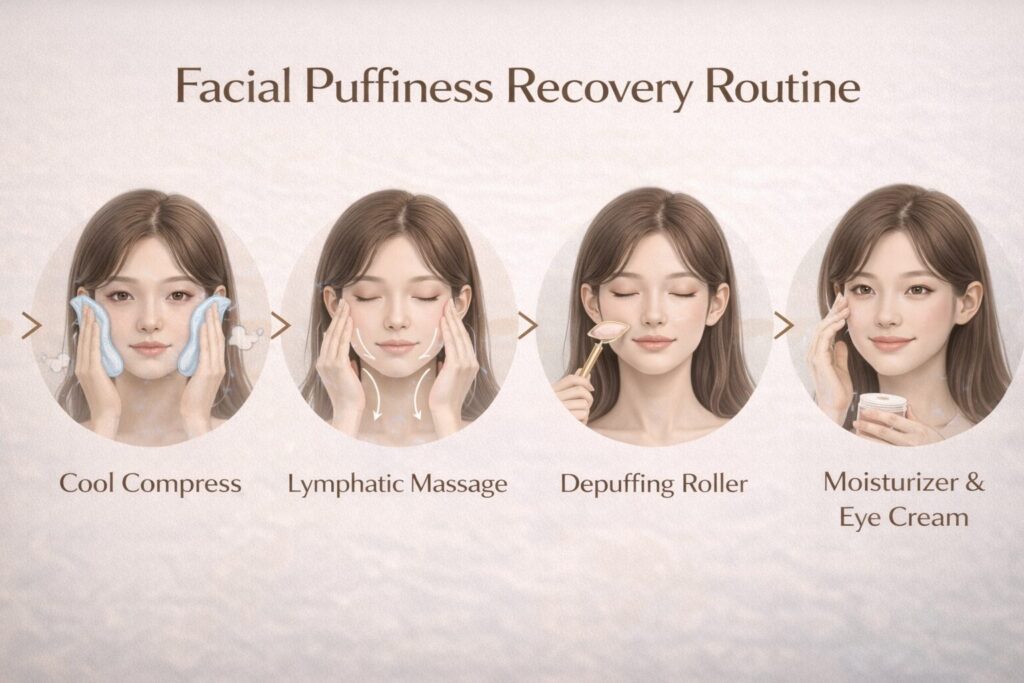
    facial puffiness recovery morning routine

    Waking up with a puffy face after late-night ramen, salty snacks, or poor sleep is a near-universal experience.
    Yet most people still approach facial swelling as something to hide, punish, or restrict.

    By 2026, global beauty routines—especially within K-Beauty and wellness communities—have shifted away from concealment toward systematic recovery.
    The goal is no longer to “fix” the face, but to restore circulation, drainage, and balance.

    Facial puffiness is not about weight gain, poor discipline, or bad skin.
    It is about where fluid stays when the body doesn’t have enough time or conditions to recover.

    This article outlines a science-aligned, non-aggressive morning routine that supports de-puffing in under 10 minutes—without harsh products, extreme fasting, or punishment-based habits.


    Why Facial Puffiness Happens After Late-Night Eating

    Before jumping into solutions, it’s important to understand what facial puffiness actually is.

    Most morning swelling is caused by:

    • Increased sodium intake → temporary fluid retention
    • Reduced sleep quality → impaired lymphatic circulation
    • Horizontal sleep posture → fluid shifts toward facial tissues

    This is not fat accumulation.
    It is temporary fluid pooling, often amplified around the eyes, cheeks, and jawline.

    Once you understand that puffiness is a positioning and recovery issue, the solution becomes clearer:
    help the body move fluid again—gently and consistently.


    1. The 3-Minute Temperature Shock (Vasoconstriction)

    The fastest visible improvement often comes from controlled cold exposure.

    Cold temperatures encourage vasoconstriction, temporarily narrowing blood vessels and reducing surface swelling.

    Practical methods:

    • Cold water splash
      Instead of lukewarm water, use cold (not painful) water.
      Splash the face 8–12 times, pausing briefly between rounds.
    • The frozen spoon method
      Keep two metal spoons in the freezer.
      Press them gently against the under-eye area and upper cheekbones for 1–2 minutes.

    This step works best when it is short, localized, and repeated, rather than aggressive.

    The goal is signaling—not shock.


    2. Lymphatic Drainage: “Opening the Exit First”

    Fluid doesn’t disappear on its own.
    It needs a pathway.

    Many people massage their face aggressively but skip the most important step:
    opening the drainage route first.

    Step-by-step logic:

    • Start with the neck
      Using clean hands, stroke gently from behind the ears down toward the collarbone.
      This prepares the lymphatic exit points.
    • Apply the center-out rule
      With a light oil, serum, or cleanser, massage from the center of the face outward—never downward.
    • Think in pathways, not pressure
      Imagine the collarbone area as the “exit zone” where fluid is meant to go.

    Pressure does not improve drainage.
    Direction does.


    3. Hydrate to De-Puff (Why Dehydration Backfires)

    A common mistake after salty food is attempting to “dry out” the body.

    This often worsens puffiness.

    When dehydrated, the body holds onto water longer.

    Better recovery choices:

    • Warm water upon waking
      Small amounts of warm or room-temperature water help reactivate internal circulation.
    • Caffeine-free herbal options
      Hibiscus tea and corn silk tea are widely used in K-Beauty-influenced routines for gentle de-bloating support.

    These options support balance without triggering additional inflammation or dehydration.


    4. The Gravity Fix: Sleep Posture Matters

    If facial puffiness happens frequently, the issue may begin the night before.

    Key adjustments:

    • Slight head elevation
      Using two pillows instead of one helps prevent fluid pooling overnight.
    • Back-sleeping when possible
      Side or stomach sleeping increases facial compression and retention.

    Small posture changes often outperform new skincare products.


    5. Keep Skincare Light on Puffy Mornings

    More product is not better when swelling is present.

    On puffy days:

    • Choose fast-absorbing hydration
    • Use fewer layers
    • Avoid heavy creams and occlusive oils

    Think of skincare as support, not stimulation.


    The Bigger Picture: Facial Puffiness Reflects Whole-Body Recovery

    Facial swelling is rarely a face-only issue.

    Light stretching, a short walk, or neck and shoulder release can improve facial appearance more effectively than topical products alone.

    Recovery is systemic.


    Key Takeaway

    Facial puffiness is not a failure.
    It is feedback.

    When you shift from restriction to recovery, results become faster, calmer, and more consistent.


    Closing Thought

    Late-night food happens.
    Poor sleep happens.

    What matters is not punishment—but how well you recover the next morning.


    Disclaimer
    This content is for general informational purposes only and does not provide medical advice.


    Explore our recovery guides:

    K-Beauty Skincare Routine 2025

    This article is for informational purposes only and does not constitute medical or professional advice.

  • 🍜 Managing Facial Puffiness After Late-Night Ramen

    It’s About Recovery, Not Punishment

    Late-night ramen is comforting, social, and for many people, unavoidable.
    Yet the next morning, the mirror often tells a different story: facial puffiness, swollen eyelids, and a heavier look around the cheeks.

    This reaction is common—and importantly, it is not a sign of failure or poor discipline.
    Facial puffiness after a salty late meal is largely about fluid balance and recovery timing, not the food itself.

    This article focuses on what actually helps the body recover naturally, without extreme restrictions or harsh routines.


    🍜 Why facial puffiness happens after ramen

    Facial puffiness is a fluid distribution issue, not a fat issue. Several factors combine after a late-night, high-sodium meal.

    🧂 Salt and temporary fluid retention

    Ramen broth is typically high in sodium. Sodium helps the body retain water, which is useful for hydration balance—but overnight, that retained water has fewer places to go.

    💧 Overnight fluid shifts

    When you lie down, gravity no longer helps fluids drain downward.
    As a result, fluid tends to redistribute toward the face and eye area, where tissue is softer.

    ⏰ Late meals reduce recovery time

    Eating late shortens the window your body has to rebalance fluids before sleep.
    This doesn’t mean late meals are “bad”—it simply means the body hasn’t finished adjusting by morning.

    👉 The key point: puffiness is about where water temporarily stays, not what you ate.


    ⭐ Quick fixes that actually help (and why)

    Many people instinctively reach for harsh methods. What works better is gentle encouragement of circulation.

    🥄 Cold spoon under the eyes (1–2 minutes)

    Light cooling causes mild vasoconstriction, which can reduce visible swelling temporarily.
    Short and localized is enough—long exposure isn’t necessary.

    💦 Cool water splash (gentle, repeated)

    A few gentle splashes stimulate surface circulation without stressing the skin barrier.

    🧍 Stay upright after waking

    Remaining upright for 20–30 minutes after waking allows gravity to assist natural fluid drainage.

    ✔ The goal is flow, not force.


    💧 Morning priorities: support recovery, don’t overwhelm it

    The morning after a late meal is not the time for aggressive detox routines.

    💧 Small amounts of lukewarm water

    Sipping water helps rebalance fluid distribution without shocking the system.
    Very cold water can sometimes cause temporary constriction that slows flow.

    🚿 Gentle, brief cleansing

    Avoid long hot showers on the face. Heat can increase redness and temporary swelling.

    🧊 Short, targeted cooling

    If you use cooling tools or patches, keep sessions short and focused.

    👉 Think assistance, not intervention.


    🧴 Skincare: less does more when swelling is present

    Facial puffiness can be worsened by heavy textures.

    🧴 Choose fast-absorbing hydration

    Light gels or fluid emulsions absorb quickly and avoid trapping excess surface fluid.

    🧴 Keep layers minimal

    Multiple layers can increase occlusion, which may prolong puffiness.

    🧴 Skip rich creams in the morning

    Heavier products are better saved for nighttime recovery.

    ✔ When swelling is present, simplicity supports normalization.


    🚶‍♀️ Wake up circulation beyond the face

    Facial puffiness often reflects whole-body circulation, not just local skin issues.

    🚶‍♀️ Light stretching

    Gentle full-body movement helps restart lymphatic flow after sleep.

    👣 Short walks

    Even a 5–10 minute walk can noticeably improve facial appearance by mid-morning.

    🧘‍♂️ Neck and shoulder release

    Tension in the neck and shoulders can slow drainage from the face.
    Simple mobility can make a visible difference.


    🌼 Psychological reset: why mindset matters

    One overlooked factor is stress response.

    Feeling guilty about food can elevate stress hormones, which may actually slow recovery.
    Viewing puffiness as temporary and normal helps the body return to balance more smoothly.


    🌼 Key takeaway

    Facial puffiness after late-night ramen is a signal, not a failure.
    It reflects fluid timing, posture, and recovery—not poor choices.

    With gentle routines and patience, puffiness typically fades naturally within hours.


    Closing thought

    Late meals happen.
    What matters more than restriction is how you support recovery afterward.

    To our global readers:
    How do you usually manage facial puffiness after a late meal?


    Disclaimer
    This content is for general informational purposes only and does not provide medical advice.


    This article is for informational purposes only and does not constitute medical or professional advice.